
How to Create a Wedding Album for a Jewish Wedding: A Photographer’s Guide
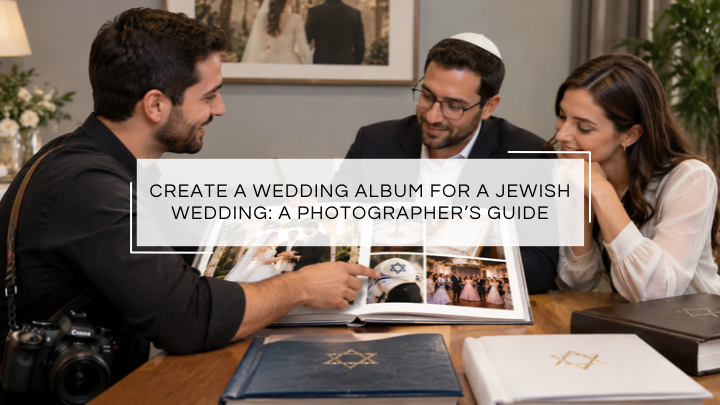
A Jewish wedding has more distinct chapters than almost anything else you’ll shoot. Two receptions happen before the ceremony even starts. There’s a legal document signed in front of witnesses, a canopy, a planned break in coverage, and a reception with its own set of rules.
If you design the album as one long run from arrival to last dance, all of that gets flattened. In Jewish wedding photography, the shape of the day should decide the shape of the book.
Know the Sequence Before You Plan the Chapters
Observance varies a lot between families, so confirm the details with the couple, and with the officiant if you can. That said, the broad order holds across most Jewish wedding ceremony traditions.
| Stage | What happens | Album treatment |
| Kabbalat Panim | Two separate receptions: the groom’s tisch, and the bride seated with her guests | Two facing pages, shot as parallel moments |
| Ketubah signing | The marriage contract is signed before witnesses | A full-page detail of the document |
| Bedeken | The groom veils the bride | Fast, crowded, emotional. Often the strongest frames of the day |
| Chuppah | Processional, circling, blessings, rings, Sheva Brachot, breaking the glass | The core chapter, paced slowly |
| Yichud | The couple’s private time alone | No coverage. Plan around it |
| Reception | Hora, chair lift, shtick, dancing | Dense spreads, high energy |
Learn how the tisch works before you shoot one. The groom tries to give a d’var Torah while his friends keep cutting him off with singing. On a day with a lot of structure, it’s one of the few stretches where you get truly candid frames.
The Ketubah Deserves Its Own Page
Many couples commission their ketubah as a piece of art, hand-lettered and illuminated, and hang it at home after the wedding.
Shoot it twice. First flat and square, evenly lit, as a document. Then again during the signing, with the witnesses around it. The flat shot goes on a full page in the album, printed large enough to read. Most coverage drops it in with the other detail shots, and that sells it short.
Yichud Is a Gap, So Plan for It
Right after the ceremony, the couple goes off alone for a short private time, often somewhere around ten to twenty minutes. You don’t photograph it.
Treat that gap as working time. Set up family formals, shoot the empty chuppah, get the reception room before guests come in, or photograph the ketubah flat. Put it in the timeline at booking so nobody sees it as lost time on the day.
The Ceremony Has More Honored Guests Than You Expect
The seven blessings, the Sheva Brachot, are often read by seven different people, called up one at a time. The families chose each of them on purpose, and the album should show every one.
The same goes for the people holding the chuppah poles, the witnesses at the signing, and the parents walking the couple down the aisle. Much of the ceremony is about honoring specific people. An album that only shows the couple misses what the families spent months arranging.
The breaking of the glass lasts a fraction of a second. Pre-focus, shoot a burst, and pick exactly one frame for the album. It’s the moment most people connect with a Jewish wedding, so get it right.
Observance Changes the Coverage, Not Just the Timeline
Photographers new to Jewish photography get this part wrong more than any other. Raise it at booking. Don’t find out on the day.
At Orthodox weddings, men and women dance separately, with a mechitza dividing the room. That means two dance floors at once, often a second photographer, and in many cases an expectation that a woman covers the women’s side. Some families also ask that photos of women and girls never appear in published work or marketing.
Some couples keep shomer negiah and won’t touch before the ceremony, which rules out the pre-wedding portrait session a Jewish wedding photographer might otherwise plan. The bedeken becomes the first look instead.
The calendar has limits too. Weddings don’t happen on Shabbat, so Saturday celebrations start after nightfall and run late, which squeezes the timeline and pushes nearly everything into the dark. Weddings also aren’t held on major holidays, during the Three Weeks in summer, or through much of the Omer period between Passover and Shavuot, though customs vary.
Photographers in cities with large Jewish communities learn this calendar fast, because it shapes their whole booking year. It’s a big part of why competition for a Jewish wedding photographer in New York is as tough as it is.
Designing the Book
Keep the chapters separate and let the pace change with each one. The common mistake in this kind of Jewish photography is the opposite: smoothing everything out to the same rhythm.
Let the pre-ceremony section breathe, with space around the bedeken frames. Keep the chuppah chapter formal, three images per spread at most, with the ketubah on its own page. The reception can run dense. If the dancing was separate, give each side its own spread instead of mixing them.
On the cover, set the Hebrew and English names together, and add the Hebrew date next to the Gregorian one if the family uses it. Ask a family member to check the Hebrew before anything prints. Transliteration varies, and design software doesn’t always handle right-to-left text cleanly.
Choose the cover material just as carefully. Genuine leather ages well. Leatherette can start peeling within a few years.
Album size matters more than usual here. Group shots at a Jewish wedding tend to be big and horizontal, so check the size guide and choose a format with a layflat spread wide enough for the full chuppah party and the hora.
What Do Families Usually Want Afterward?
Both sets of parents usually want copies. Grandparents often do too, and sometimes the couple wants a smaller version for themselves.
Order parent copies in the same production run as the main album. The design work is already done, so duplicates are the cheapest thing on the order. A reprint two years later won’t be.
Where Sood Studio Fits?
Sood Studio has made albums since 1947 and supplies photographers, studios, and families across the USA and UK.
Trade accounts get wholesale pricing with volume tiers. Production templates come matched to your spread count and spine width, which removes the most common reason files get rejected. You can see how the whole process works before you commit to an order.
If you shoot Jewish weddings regularly, order a sample built from one of your own ceremonies and check how a full-width chuppah spread sits across the spine. That one test will tell you more than any spec sheet.
Before Your Next Jewish Wedding
Think of the day as five chapters, not one timeline. Give the ketubah its own page, the honored guests their frames, and separate dancing its own spreads. Plan around yichud instead of apologizing for it.
Most of all, ask the couple about their level of observance when they book, not the week before. The coverage depends on that conversation, and so does the album.