
How to Compare Wedding Album Labs Before Choosing a Production Partner
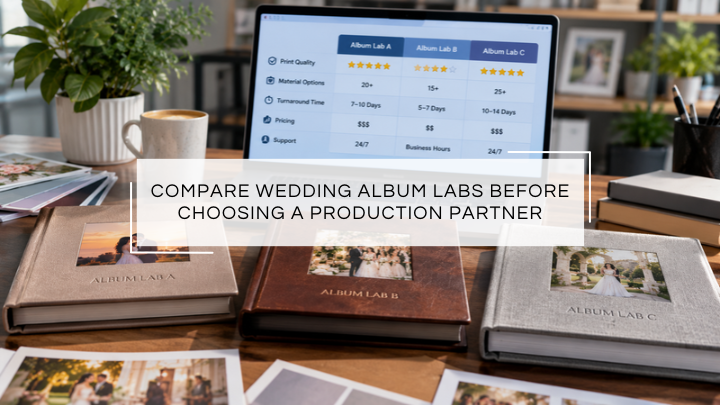
Most studios choose a lab by reading websites and ordering one sample. That tells you what a lab can do on its best day, with a file it chose, under no deadline pressure.
A comparison is different from a sample request. It means putting two or three wedding album printing services through the same test at the same time, with your files, and measuring the results against each other rather than against a vague sense of quality.
It costs a few hundred dollars and about three weeks. Set against a season of work that is cheap.
Build the test file before you contact anyone
Use the same set of images for every lab. Without that, you are comparing their image choices rather than their printing.
A useful test file holds six to ten spreads and includes:
- A full-bleed spread with a face crossing the spine, so you can measure gutter loss
- A frame with skin tones in mixed light, which is where color management shows
- A near-black reception shot, to see whether shadow detail survives
- A saturated red or deep blue, the two colors that shift most between printers
- A neutral gray area, which should stay neutral rather than drifting green or magenta
- Fine text on the spine or cover, to check registration
Specify identical size, page count, paper weight, and cover material across all three orders. Where a lab cannot match a specification, note it. That is useful information rather than a problem.
Score what you can actually measure
Opinions about quality are hard to compare three weeks later. Numbers are not.
| Criterion | How to measure it | Weight |
| Gutter loss | Lay a straight edge across the spread and measure how much image the fold consumes | High |
| Lay-flat behavior | Open to the middle spread, release, and see whether it stays flat | High |
| Color accuracy | Compare prints to your calibrated monitor under daylight, then under indoor light | High |
| Shadow detail | Check the near-black frame for blocked-up areas | Medium |
| Neutral stability | Confirm the gray area has not shifted color | Medium |
| Spine registration | Measure whether the cover text sits centered | Medium |
| Page feel and weight | Compare thickness and stiffness by hand against the quoted gsm | Medium |
| Box and finishing | Corners, edges, and whether the box fits properly | Low |
Score each out of five and apply the weights. Across three wedding album manufacturers the winner is rarely the one you expected after reading their websites.
Compare landed cost, not unit price
Unit price is the number labs advertise and the least useful one for comparing wedding album manufacturers.
Add the shipping, inbound and outbound. Add customs and duties if production sits overseas. Add the design hours each lab costs you, which varies more than people expect, since a supplier that provides templates matched to your page count and spine width removes work that another supplier leaves with you. Then add your estimated reprint risk, based on how their preflight process actually works.
Two labs quoting within ten percent of each other on unit price can land thirty percent apart once all of that is counted.
Ask the commercial questions in writing
Verbal answers drift. Email answers do not.
- Where do the wholesale tiers break, and at what quantities?
- Is there a minimum order?
- What are the payment terms?
- Will they ship blind, with your branding and none of theirs in the box?
- How long do they archive press-ready files for reorders?
- What is the reprint policy, and does it have a stated window?
Most photo album manufacturers serving the trade have all of this documented and send it the same day. A supplier who improvises these answers on a call is showing you how the next three years will go.
Test the process, not just the product
Product quality is one variable. The way an order moves through the building is another, and it only reveals itself under real conditions.
While your test orders run, track four things. How long after upload did each lab confirm the files passed or failed. Whether you were told the album had entered production or had to assume. Whether tracking arrived automatically. And how long a straightforward email question took to get a human reply.
A lab that publishes how its process runs is easier to hold to an answer than one that keeps it vague.
Then test it again in six months
This is the step almost nobody takes, and it separates wedding album labs that hold a standard from ones that happen to have had a good week.
Reorder the same album from your chosen supplier half a year later. Few wedding album printing services will volunteer how much their output moves over time, so measure it yourself. Put the two copies side by side. If the color has drifted, that is what happens to a parent copy ordered after the original, and families notice immediately when the two books do not match.
Consistency across time is the hardest thing for a lab to deliver and the easiest thing to forget to test.
If you are a couple rather than a studio
You are not going to run this comparison. Your photographer should have.
Reasonable questions: where are the albums produced, how long has the studio worked with that supplier, and can they show you a finished album rather than screen images.
Ask whether parent copies can be ordered at the same time, since duplicates bought alongside the original cost far less than a reprint later.
Where Sood Studio fits?
Sood Studio has manufactured albums since 1947 and supplies photographers, studios, and families across the USA and UK.
Trade accounts carry wholesale pricing with volume tiers. The range covers album sizes, cover materials in leather and leatherette, presentation boxes and briefcases, and parent book formats for duplicate copies. Production templates are matched to your spread count, which removes the most common cause of file rejection before it happens.
There is no reason to take any of that on trust.
Put Sood Studio in the comparison alongside the other photo album manufacturers on your shortlist. Order a sample with your own test file, score it against the table above, and judge it next to whoever you are using now.
Where does this leave you?
The comparison is worth running once, carefully, rather than repeatedly by accident over several disappointing orders.
Same files to every lab. Measured criteria rather than impressions. Landed cost rather than unit price. Commercial terms in email. And a repeat order six months on to confirm the first result was not luck.
Three weeks of effort, and then the question is settled for several years.