
Bar Mitzvah vs Bat Mitzvah Albums: What Photographers Should Know
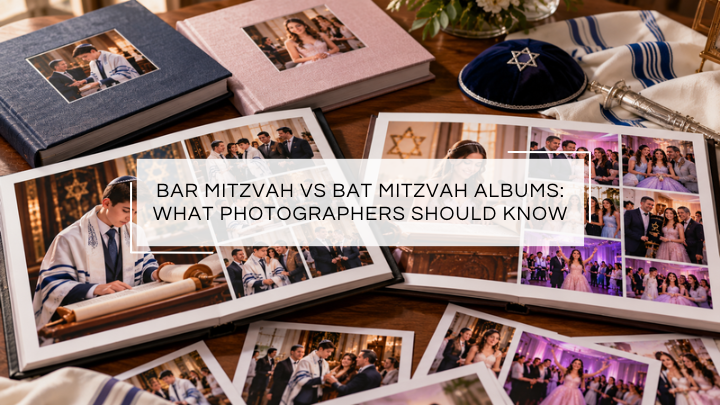
Studios booking this work for the first time usually expect the difference to be about gender. It mostly isn’t.
A bar mitzvah and a bat mitzvah in the same Reform congregation produce near-identical albums. A bat mitzvah in an Orthodox community and one in a Reform community produce very different albums, even though both are bat mitzvahs. The variable that actually matters is the family’s denomination and the service they are holding, not the child’s gender.
That changes the questions you ask at booking.
The ceremony chapter is where albums diverge
What you can photograph and whether there is a synagogue ceremony to photograph at all, depends on the community.
| Category | Reform and most Conservative | Orthodox |
| Bar mitzvah | Torah reading, aliyah, d’var Torah, tallit | Torah reading, aliyah, d’var Torah, tallit |
| Bat mitzvah | Essentially parallel to the above | Often no Torah reading in the main service; may be a d’var Torah, a women’s tefillah, or a celebratory meal |
| Shabbat photography | Varies by congregation, sometimes permitted if unobtrusive | Not permitted during the service |
| Practical result | A full ceremony chapter from live coverage | A ceremony chapter built from a separate session |
The last row is the one that shapes the whole album. When live coverage is not possible, Bat Mitzvah Albums in those communities lean almost entirely on a pre-event portrait session and on the celebration afterward.
Plan the session accordingly, with the outfit, the synagogue if they allow it, and the Torah if the family can arrange access. Bar Mitzvah Albums from the same communities usually keep a full ceremony chapter, since the boy’s service can be covered where the congregation permits it.
Ask which movement the family belongs to and which service they are holding before you quote. Friday evening, Saturday morning, Saturday afternoon and a Saturday night Havdalah all behave differently, and the last one is worth knowing about because Havdalah happens after Shabbat ends.
The candle is lit, photography is permitted, and it is one of the better frames of the night.
Age is a real difference, and it is small
In Orthodox practice a girl reaches bat mitzvah at twelve while a boy reaches bar mitzvah at thirteen. Most Conservative and Reform communities use thirteen for both.
Twelve and thirteen are not the same at the portrait stage. A year matters enormously at that age, and the posing and direction that works for one often reads as awkward for the other. It is worth planning a longer, gentler session for the younger end rather than running the same shot list on autopilot.
The reception is where coverage genuinely changes
In Orthodox celebrations, dancing is usually separate, with men and women in different spaces. That is not a minor scheduling note. It means two dance floors running at once, two sets of images, and often a need for a second photographer so neither side goes uncovered.
It also affects who should be holding the camera. Many families will expect a female photographer for the women’s dancing, and some will ask that images of women and girls are not published or used in marketing at all. Raise this at booking rather than discovering it when you send the gallery.
Everything else at the party tends to be shared ground. The candle lighting ceremony, usually thirteen candles for thirteen honored people. The montage. The hora and the chair lift. The sign-in board or book. A theme the child chose and cares about more than anyone expects.
What belongs in every album regardless?
A few things carry across all of it, and they are frequently missed.
The mitzvah project. Many children spend months on a charitable project leading up to the date, and almost nobody photographs it. A single spread showing that work gives the album something the party pictures cannot, and families notice its absence more than its presence.
The d’var Torah. The speech is the reason for the day. It deserves a quiet single page, not a thumbnail in a grid.
The parsha. Every child reads a specific Torah portion, and that portion is personal to them. It can open the ceremony chapter or sit on the cover.
Grandparents. For many families those frames outrank the dance floor entirely.
Covers, names, and the thing to proofread twice
Hebrew name and English name, usually set together, with the Hebrew date alongside the Gregorian one if the family uses it.
Have a family member check the Hebrew before anything prints. Transliteration varies, software handles right-to-left text unpredictably, and a misspelled name on a cover cannot be corrected afterward. This single step prevents more reprints on Bar Mitzvah Photo Albums than any other check.
Keep religious motifs restrained. A small debossed detail outlasts a decorative cover the child grows out of by sixteen. Genuine leather suits the parents’ copy, and Sood Studio’s leather options tend to be where families spend when they want the album to feel permanent. Leatherette peels within a few years, which defeats the purpose.
What to offer?
Most families want more than one copy, and the conversation goes better before delivery than after.
Most Bar Mitzvah Photo Albums and Bat Mitzvah Photo Albums run 20 to 30 spreads. Parent and grandparent copies take the same design at a smaller size, which makes them the cheapest reprint anyone will order.
The sign-in book comes from the pre-event session and has to be printed before the date, not after. A presentation box protects all of it.
For studios building this into a service line, the production questions matter as much as the design ones. Sood Studio has manufactured albums since 1947 and supplies photographers, studios, and families across the USA, with trade pricing for volume orders, finishes across hum, gloss, matte and luster, silk, and metallic, and templates matched to your spread count so the cover and spine stay in step with the page count.
Where does this leave you?
Treat the denomination as brief. Bar Mitzvah Albums and Bat Mitzvah Albums from the same congregation will look like siblings.
Bat Mitzvah Photo Albums from two different communities may share almost nothing structurally, and designing both from one template is how studios end up with a book that misses the point of the day.
Ask about the movement, the service, the dancing, and the publishing permissions at booking. Then design the ceremony chapter around what you are actually able to photograph.