
How to Choose a Reliable Wedding Album Printing Partner?
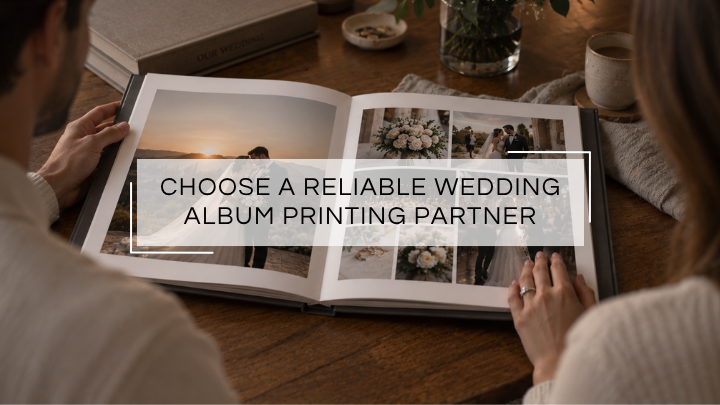
Your album is the last thing a couple physically keeps from their wedding day. It gets opened on anniversaries, passed around at family dinners, and handed down. The lab behind it decides whether it still looks right in twenty years.
Most album problems only appear after delivery. Flat skin tones. A spine that creaks on the third opening. A spread cut in half by the gutter. You can catch every one of them before you order.
Here is the checklist to run before you commit to any wedding album printing partner. It is the same checklist we hand our own clients at Sood Studio, where we have been printing wedding book albums since 1947.
1. Start with the print method
Two methods dominate professional wedding album printing in the USA.
| Photographic printing | Press printing | |
| How it works | Light exposes silver halide paper, chemistry develops it | A digital press lays ink or toner onto the sheet |
| Strongest at | Skin tones, soft gradients, dark reception frames | Fine text, heavy ink coverage, thicker stocks |
| Page character | Smooth photographic surface | Wider range of textures and weights |
Neither one is wrong. What matters is that the lab tells you which method it runs, which paper it uses, and the weight in gsm. Album stocks generally run from about 190 gsm for flush-mount sheets up to 350 gsm and higher for mounted layflat pages.
2. Compare the paper finishes yourself
Finish changes the mood of every image on the page. Ask what the lab stocks, then look at the options side by side:
- Gloss: deepest blacks and strongest color, but it holds fingerprints
- Matte and luster: low reflection, easy to view under any lighting
- Silk: soft sheen that hides handling marks
- Metallic: adds depth to jewelry, sequins, and reception lighting
Sood Studio prints on hum, gloss, matte and luster, silk, and metallic stock, so you can match the finish to the shoot instead of accepting whatever the lab happens to run that week.
3. Test the color workflow before the full order
Color causes more reprints in wedding album printing than anything else. Four questions settle it:
- Which color space does the lab accept, sRGB or Adobe RGB 1998?
- Do they want an ICC profile embedded in the file?
- Do they apply automatic color and density correction by default? Many labs do, and it will fight an image you have already graded. Ask them to switch it off in writing.
- Will they print one test page from your own edit before the full run?
On your side, calibrate your monitor to a D65 white point at roughly 100 to 120 cd/m² before you soft proof. A screen at full brightness makes every print look dark by comparison.
4. Look at the binding, not the cover photo
Layflat construction is why wedding books and albums cost more than a standard photo book.
- Hinged layflat pages open a full 180 degrees, so a panoramic spread crosses the spine without loss
- Standard perfect binding swallows roughly a quarter inch into the gutter, enough to cut a face in half
- Ask for the board thickness, the hinge type, and the page count the binding holds before it strains
Cover material decides how the album ages. Genuine leather develops patina. Leatherette peels. You can see the full range on the Sood Studio leather options page.
5. Ask what the album ships in
Presentation and protection are part of the product, not an upsell. A good partner offers real choice here.
Ours includes:
| Box style | Works well for |
| Flap box and overlap box | Everyday shelf storage and clean presentation |
| Plain box | Simple, budget-friendly protection |
| Flap briefcase and new briefcase | Handing the album over in person |
| Acrylic box | Display pieces and studio showrooms |
| Customized box and leather bags | Branded delivery for photographers |
6. Check the wedding album design support
Some labs only print. Others handle wedding album design as well. Ask which you are getting.
If you design in-house, request the production template and confirm:
- Page dimensions, bleed at the standard 0.125 inch, and safe margin
- Spine width for your exact page count, requested only after you lock the spreads
- File format, usually flattened TIFF or maximum-quality JPEG at 300 dpi at final size
If you want the lab to design, ask how many revision rounds are included, how fast the first proof comes back, and who owns the layout file afterward.
Couples ordering directly almost always need this support. Studios with an established wedding album design workflow usually just need clean templates and consistent output.
7. Get dates and trade terms in writing
About two weeks means nothing on its own. Ask when the clock starts, at file upload, at proof approval, or at payment. Then ask for production time and transit time as two separate numbers. Fall is the peak season across US studios, so build in extra room from September through December.
Photographers should also ask:
- Where does wholesale pricing drop by volume?
- Does the lab ship blind, with your studio branding and none of theirs in the box?
- What are the minimum order quantities and the reorder price for duplicate and parent albums?
- How long are press-ready files archived, so a reprint two years later does not mean rebuilding the album?
Sood Studio runs trade accounts with wholesale pricing and ships to studios across the USA, so photographers can quote albums to clients with a known cost per copy.
8. Order a sample before you commit
Nothing on a website tells you how a page turns. Order one sample album using your own images, including a dark reception frame, a bright outdoor portrait, and a full-bleed spread across the spine.
When it lands, check four things:
- Skin tones under daylight and again under warm indoor light
- Detail in the darkest part of the frame
- Whether the spread truly sits flat when you press it open
- The finishing on the cover edge and corners
If the sample holds up on all four, you have found a printing partner rather than a print shop.
Ready to compare for yourself?
Sood Studio has handled professional wedding album printing for photographers and families since 1947, with a full range of finishes, covers, and boxes made to order.
Request a sample album, put it through the four checks above, and judge the work in your own hands.