
Best Photo Album Designs for Bar and Bat Mitzvah Photography
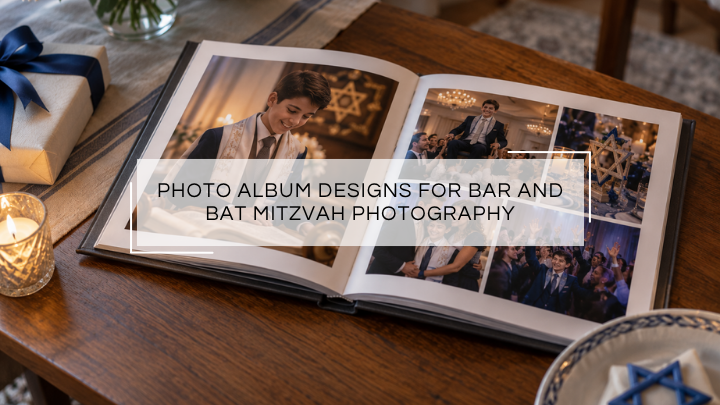
A bar or bat mitzvah is two events wearing one name. There is a service, which is quiet, formal, and religious. Then there is a party, which is loud, lit by a DJ rig, and built around a thirteen year old and their friends.
Most albums fail because they treat both halves the same way. The design has to shift with the day, or the reception spreads will bury the moment the child read from the Torah.
Here is how to structure the album so both halves survive.
Design the two halves differently
| Service and portraits | Party | |
| Pacing | Slow, fewer images per spread | Dense, energy-driven spreads |
| Layout | Generous white space, single-image pages | Grids, full-bleed spreads, overlapping action |
| Color | Restrained, warm, neutral backgrounds | Whatever the uplighting did, kept as shot |
| Must-include frames | Torah reading, tallit presentation, the d’var Torah, family on the bimah | Hora and chair lift, candle lighting, the dance floor |
| Finish | Matte or luster, which holds detail without glare | Gloss or metallic, which suits club lighting |
Keep them as separate chapters rather than mixing them chronologically once the party starts. The tonal shift is the point.
Build the sign-in book from the pre-shoot
Many synagogues do not permit photography during a Shabbat service. That is why most US photographers run a separate portrait session before the date, often at the synagogue or on location with the outfit, the tallit, and the Torah.
Those frames do more than fill a gap. They become the sign-in book, which guests write in at the party.
- Keep it to 20 to 30 pages so guests find open space quickly
- Leave real writing room. Half the spread should stay empty by design
- Use a landscape format, which sits better on a sign-in table
- Print on a finish that takes pen ink without smearing
- Order it early, because it has to arrive before the event rather than after it
This is the one product photographers most often skip, and it is the easiest to sell.
Pick the format that matches the family
| Format | Best for |
| Layflat album, 10×10 or 12×12 | The main keepsake, with spreads that cross the spine cleanly |
| Magazine-style photo book design | A lighter, lower-cost second copy for the child’s own shelf |
| Sign-in book | Guest messages built on pre-shoot portraits |
| Parent and grandparent copies, 8×8 | Same layout, smaller size, cheapest reprint on the order |
| Box set | Album plus loose prints, the invitation, and the kippah |
Most main albums land between 20 and 30 spreads. Below 20, the party gets squeezed. Above 30, the pacing sags.
Get the cover right
The cover carries the name and the date, so the details matter more here than on any other page.
- Set the Hebrew name and the English name together, and have a family member proofread the Hebrew before printing
- Include both the Gregorian date and the Hebrew date if the family uses it
- Choose foil color deliberately. Gold suits warm leather, silver suits cool grays and blues
- Keep religious motifs simple. A small debossed detail outlasts a decorative cover the child grows out of
- Match the cover material to who keeps the album. Genuine leather ages well for the parents’ copy, while a bolder color often suits the child’s
Decide all of this before you create photo album design layouts, because spine width depends on the final page count and the cover artwork has to fit it.
Layout rules that hold up
Good photo album design for this event follows a few hard rules:
- Keep faces out of the gutter. A layflat binding opens a full 180 degrees, but the fold still sits at the center of the spread
- Build to 300 dpi at final print size, with 0.125 inch bleed on every edge
- Give the candle lighting its own sequence. Thirteen candles usually means thirteen honored people, and cutting that short upsets somebody
- Run the d’var Torah as a quiet single page, not as a thumbnail in a grid
- Limit yourself to three images per spread in the service chapter and up to six in the party chapter
- Include the grandparents properly. For many families, those frames outrank the dance floor
If you already build wedding albums, adjust these three things
Studios coming from wedding album design have the workflow, but the content differs.
- The subject is a minor. Get written parental approval before using any image in your portfolio or on social, and honor requests to keep the child offline entirely.
- The guest list splits by age. A wedding album leans on couple portraits. Here the friend group matters as much as the family formals, so give the kids their own spreads.
- The religious section is not optional. A wedding album can open at the ceremony and move on. A mitzvah album that treats the service as preamble misses what the day was for.
Everything else carries over. The same templates, the same color workflow, and the same discipline your wedding album design work already runs on.
Order the family copies at the same time
Parents, grandparents, and the child often all want a copy, and a reprint ordered two years later costs more than a duplicate ordered on day one.
- Build one layout, then output it at two sizes
- Order all copies in the same production run for consistent color across the set
- Ask how long the lab archives press-ready files, in case the family comes back later
- Confirm the turnaround before you promise a delivery date, since fall and spring both run heavy with mitzvah season
Where Sood Studio fits?
Sood Studio has manufactured albums since 1947 and produces bar and bat mitzvah work for photographers, studios, and families across the USA.
- Finishes: hum, gloss, matte and luster, silk, and metallic, so the service chapter and the party chapter can each get the right surface
- Covers: the full leather range, plus linen, velvet, and acrylic options with foil, debossing, and bilingual name setting
- Boxes: flap boxes, overlap boxes, acrylic boxes, briefcases, and leather bags for presentation
- Trade support: wholesale pricing, production templates matched to your exact page count and spine width, and reorder pricing on parent and grandparent copies
Before you create photo album design files for a full order, request a sample. Hold the paper, open the layflat spread, and check the foil against the leather. Photo book design decisions are far easier to make with the product in your hands than on a screen.
Order the sample, show it to the family at the consultation, and let the album sell itself.