
Why Digital Photos Don’t Feel the Same as a Physical Wedding Album
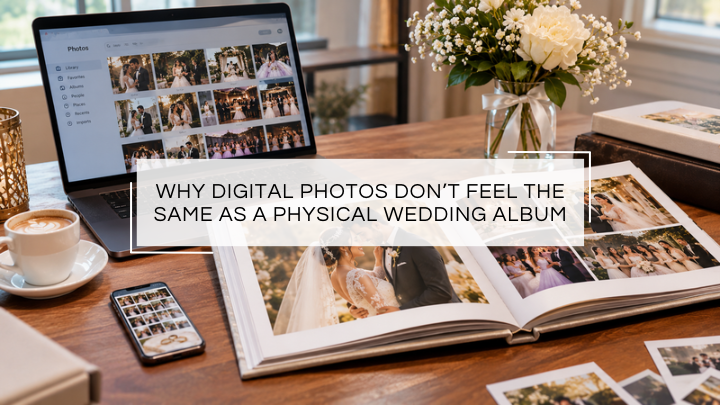
Couples notice this before they can explain it. The gallery arrives, everyone looks through it once, and the reaction is warm but oddly flat. Then a printed album turns up months later and the same images land completely differently.
It is not nostalgia and it is not a sales argument. The two formats present photographs under genuinely different conditions, and most of the difference comes down to four things: size, light, order, and who is in the room.
The physical differences are measurable
| Feature | On a screen | In a printed album |
| Viewing size | Around six inches on a phone, one image at a time | A 10×10 album opens to roughly twenty inches across |
| Light source | The screen emits light directly into your eye | Light falls on the page and reflects back |
| Order | Whatever the gallery sorted by, usually filename | Fixed, chosen, with a first page and a last one |
| Length | Open-ended. There is always more | Finite. It ends, so people finish it |
| Audience | One person holding a device | Three or four people around a table |
None of those are small. A face printed across a full spread is several times the size it appears on a phone, which is the whole reason a photographer composed it wide in the first place.
Emitted light and reflected light are read differently
A screen pushes light at you. A print sits under whatever light is in the room, so the image changes slightly as the day does, and your eye reads it the way it reads everything else physically.
This is also why screen-perfect digital pictures can look flat in print and why good labs insist on a proofing process. Different viewing conditions, different results. It is not a defect in either format.
The practical consequence for a photographer is that an image edited at full screen brightness, late at night, will not look the same on paper. That gap is closed by calibration and test prints rather than by hoping.
A gallery has no end, so nobody finishes it
Eight hundred images with no fixed order is an archive. People scroll archives. They do not read them.
A physical wedding album makes three decisions on the viewer’s behalf. Which images? In what order. And when it stops. Those decisions are the actual product. The paper is just what carries them.
This is why digital photo books that simply dump an entire gallery into a template rarely satisfy anyone. The format changed but the editing never happened, and the editing was the part that mattered.
It is a shared object, not a personal device
A phone is held by one person at a reading distance of about a foot. Anyone else is looking over their shoulder.
An album sits open on a table and three or four people look at the same spread simultaneously, pointing at things, talking over each other. Nobody receives a notification halfway through. Nobody gets pulled into another app.
That one difference accounts for most of what couples mean when they say the album feels more real. It is not the paper. It is that the photographs became something a family does together rather than something a person checks.
Discovery matters more than anyone admits
A folder requires intent. You have to decide to look, find the device, locate the folder or the link, and sometimes remember a password.
A book on a shelf requires none of that. Someone picks it up because it is there. Over twenty years that difference compounds enormously, which is why a physical wedding album gets opened hundreds of times while the album digital photo files from the same wedding get opened twice.
Where each format earns its place?
Neither one replaces the other, and photographers should stop framing it that way to clients.
The digital files are for sharing, reprinting, and keeping safe. They are the master copy and they should be backed up properly. A digital photobook works well as a lightweight second copy, a proof for approval, or something to hand a guest. Treat the album digital photo files as the master set and the printed book as the version people actually live with.
The print is for the eighty images that carry the day. Build it properly, since construction determines whether it survives being handled: layflat binding so a spread crosses the spine without cutting through a face, paper with enough weight to turn cleanly, and a cover material that ages rather than peels.
For photographers, this is a selling problem, not a product problem
You cannot explain this difference. Couples who have only seen their images on a screen have no reference point for what a spread looks like at twenty inches.
So stop describing it. Put a sample album in their hands at the consultation, before they have seen a single frame of their own. Attachment rates for albums are far higher when the conversation happens at booking than when it happens after the gallery goes out, and the reason is simply that they have held one.
Two practical steps. Keep one current sample in the studio and replace it when your work changes, since a digital photobook on a tablet will not do the same job in that conversation. And order it with your own images rather than showing a lab’s demo book, because the couple is buying your photography, not the lab’s.
What to tell couples who are deciding?
They are usually weighing a printed album against doing nothing, not against another product.
Worth saying plainly: digital pictures and prints do different jobs. Keep the files, back them up, and print a selection. Order parent copies in the same run as the original, since the design is already done and duplicates are the cheapest thing on the order.
Sood Studio has manufactured albums since 1947 and supplies photographers, studios, and families across the USA and UK. Trade accounts carry wholesale pricing with volume tiers, and production templates arrive matched to your spread count.
Where does this leave you?
The difference between a gallery and an album is not sentiment. It is twenty inches instead of six, reflected light instead of emitted, a fixed order instead of none, and four people instead of one.
Digital photo books and galleries do work that print cannot, and the reverse is equally true. The mistake is treating the files as the finished job, because a folder nobody opens is not a record of anything.